How Much Does Tree Removal Cost in the Shenandoah Valley?
- Derrick Lawson

- Aug 13
- 10 min read
Updated: 6 days ago
Most tree removals here run $1,500 to $4,500. Here is what actually drives that number, why we price by methodology instead of tree size, and what stump grinding, crane work, and emergency calls really cost.

The short answer
Most tree removals in the Shenandoah Valley cost $1,500 to $4,500 per tree. Really large trees run $6,000 to $10,000, a job that needs a crane adds $2,000 to $3,000 on top, and stump grinding is a separate line item starting at $350. Estimates are free.
That is the honest range, and it is wide for a reason. The reason is not the one most people expect.
Why tree removal cost has almost nothing to do with tree size
Homeowners usually assume a bigger tree means a bigger bill. In practice, size barely moves the number. Placement and health do.
Consider two trees. An 18 inch diameter tree can easily be 80 feet tall. A 36-inch tree can be 35 feet tall. Height and diameter do not track each other, and past about 3 feet in diameter, everything is heavy no matter what, so the diameter stops telling you much at all.

30 minutes
Standing alone in an open field.

4 to 5 hours
Same tree between two houses, power on one side
Same tree. Same wood. Roughly five times the labor.
So we price by methodology: what it will actually take to get that specific tree safely to the ground from where it stands. That is why an estimate has to happen on site, and why any company quoting a firm price over the phone from a photo is guessing.
Tree removal cost by size, with good access
If a tree is healthy, reachable, and has room to work, these ranges hold up:
Tree height | Typical cost | Notes |
|---|---|---|
Under 30 feet | $1,000–$1,500 | Straightforward removal, good access |
30 to 60 feet | $2,000–$2,500 | Most residential removals land here |
60 to 80 feet | $3,500 and up | Depends on diameter and wood volume |
Large or complex | $6,000–$10,000 | Multiple targets, tight access, exceptional size |
Crane required | Add $2,000–$3,000 | On top of removal cost, for the crane day |
Stump grinding | From $350 | Always a separate line item |
Read those as starting points, not quotes. Every one of them assumes the truck can get close and the tree is sound. Change either of those and the number moves.
What actually drives the price up
Targets underneath the tree
A target is anything that would be damaged if a piece came down wrong: a house, a fence, a shed, a garden, a driveway, a power line. Every target added means slower, more controlled work. A tree surrounded on three sides with power on the fourth is a completely different job from the same tree in a pasture.
Access and carry distance
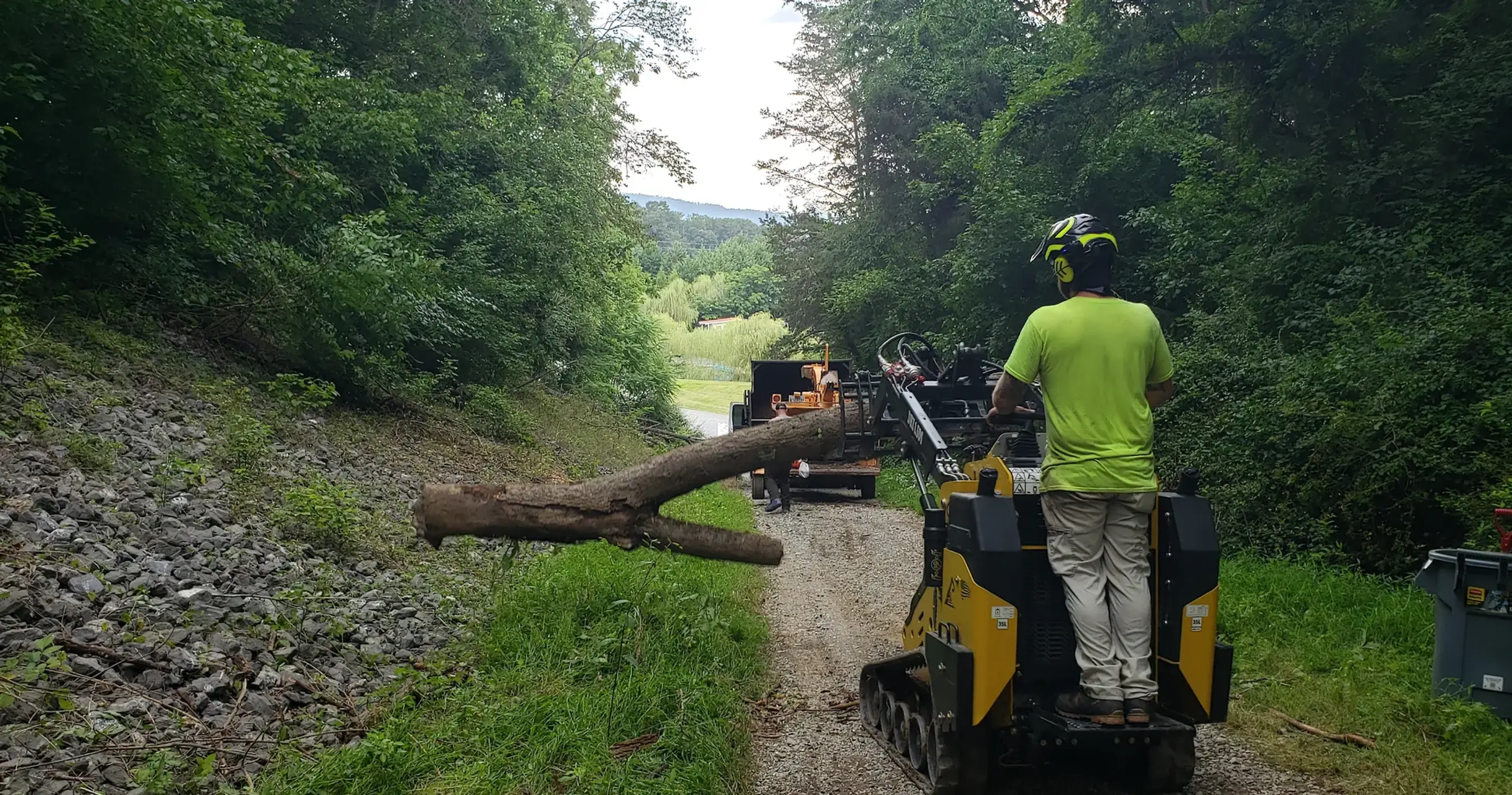
This one surprises people more than anything else. A backyard reachable only through a 36-inch gate means nothing gets driven in. Every piece is hand-cut, blocked down to firewood size, and carried roughly 100 feet to the truck, one armload at a time.
“The closer I can get the truck, the cheaper it is, because it's faster.”
Derrick Lawson
Whether the tree is dead
A dead tree changes everything, because it changes the method. It is not a surcharge; it is a different job.
A normal climbing takedown uses negative rigging, where the rigging point sits below the cut. The block catches each falling piece as a shock, and that force transfers straight into the tree. The tree has to be structurally sound enough to take it. The physics are unforgiving: drop a one-pound object eight inches, and it doubles its weight in impact force. Now do that with a thousand-pound piece of timber at 60 feet.
A dead, decayed, or stress-fractured tree cannot absorb that. So it either gets a crane, which lifts pieces away with no load transferred to the tree at all, or it gets climbed very slowly in small pieces. A 30-foot tree that takes four hours to climb is a $2,000 tree, even though a healthy one the same height might be half that.
Distance from our base
We work roughly an hour out from Elkton. Jobs near the edge of that radius carry the travel in the price. Inside the core service area, it is not a factor.
How much does crane tree removal cost?
A crane day adds $2,000 to $3,000 to the removal cost. It is worth understanding when that is money well spent, because it is not an upsell.
Three things decide it: access to the tree, what sits underneath it, and whether the tree is structurally sound enough to be rigged at all. When a tree is dead, decayed, or fractured, rigging it means loading a structure that has already failed once. A crane inverts the problem. It lifts each piece away rather than dropping it, so nothing shock-loads the tree, and the climber is not tied into something that might let go.
It is also frequently faster. A crane job that finishes in a day can cost less overall than three days of careful hand rigging, and most tree services in this Valley do not do crane work at all. Derrick trained on cranes almost exclusively during his years in Boston, where the company he worked for owned one and rented a second.
How much does stump grinding cost?
Stump grinding is always a separate line item, because it is a separate machine that has to be brought out. We ask about it during every removal estimate.
$350
Minimum charge — a man and a machine for about an hour
$700–1,000
A 20-inch stump at full depth
$1,500–2,000
A 36-inch stump
Pricing is per stump and time-based, not per inch. Two things move it. Wood type matters, because fresh, wet hardwood grinds far slower than punky or soft wood like pine. Depth matters more, because full depth is the time-consuming part. If you only need the stump flattened rather than taken down fully, that costs less.
We guarantee 6 inches below grade, which is full depth for the average stump, and often go deeper. Grindings are left in place by default. That is deliberate: a living tree pulls minerals and nutrition out of the soil its whole life, and letting the grindings break down in place returns that content to the ground and starts making the spot healthy again. We haul them on request.
Most stumps take about an hour. Larger or harder ones take one to two.
How much does tree pruning cost?
Pruning starts around $750 for the smallest jobs. The average job runs about $4,000, and large jobs run $10,000 to $15,000.
There is one reliable way to pay less: prune in the dormant window. Most deciduous trees in this Valley, especially oaks and hardwoods, should be pruned between January and March anyway, and we discount winter pruning 10 percent to push work into the window that is actually best for the tree. That is not a promotion; it is the correct time of year.
10% off
Pruning booked in the January to March dormant window. The only discount we run.
What is included in the price
Hauling and processing are built into every removal price. There is no separate debris fee and no dump charge added at the end.
You can ask us to leave the wood, and people often do for firewood, but it barely changes the price. The equipment comes either way, and bucking wood down to firewood lengths takes about as long as loading and hauling it. The price is the process and the haul away.
The one thing that is genuinely separate is stump grinding, for the reason above.
How much does emergency tree removal cost?
More than scheduled work, and we will tell you that plainly rather than hide it. The premium varies with distance, the equipment the situation needs, and how much it disrupts the existing schedule, so it is priced per situation rather than as a fixed percentage.
What you get for it: we answer the phone in about 30 seconds most of the time, and within about 10 minutes at worst. On-site response runs from 20 minutes to roughly an hour and a half, depending on how far out you are. Emergency response runs Monday through Saturday. We are closed on Sunday.
Tree on a power line?
Call the utility first to cut power. Then call us.
Does homeowners insurance cover tree removal?
Usually only after the tree has already fallen on the house. Insurers generally will not pay to remove a declining tree before it fails, which creates a trap worth knowing about.
“You can tell them, hey, this thing's in bad shape, we should take it down before it hits the house. Well, we're not paying for it till it falls. But then they're gonna say, " Well, you knew it was bad.”
Derrick Lawson
If a tree falls and you knew it was in poor condition, the insurer can call that negligence and deny the claim. So the coverage runs out at both ends: no payment beforehand, and possible denial afterward. That asymmetry is the strongest practical argument for handling a declining tree on your own schedule.
We bill the homeowner directly and do not work through adjusters. You file your own claim, and we give you extensive photo and video documentation from before and during the work to file with it. This is general information rather than legal or coverage advice, so read your own policy or ask your agent.
How the estimate works
Estimates are free. So are tree health assessments. Always, with no exceptions and no trip charge for the visit.
An estimate visit takes about an hour, sometimes as little as 20 minutes. It opens with a question most tree companies never ask: do you want to save it? Most homeowners do not realize saving the tree is an option, because nearly everyone in this trade sells removals. If pruning, treatment, or soil work can turn the tree around, that gets offered first.
If removal is the right answer, we evaluate the methodology on the spot, ask whether you want the stump ground, and price the whole package before leaving, unless it is a very large multi-tree project.
Every proposal includes
· A copy of our insurance policy
· The service and terms agreement
· A Google Maps image of the property with the work trees pinned, so there is no ambiguity about scope
Usually in your email before we are out of the driveway.
Payment, deposits, and scheduling
Depositsis | None, unless the project is over $10,000 — then 10 percent. |
Payment terms | Nothing due until the work is finished; then due upon receipt. |
Methods | Check, cash, ACH, and credit card. |
Booking | Scheduled work typically books two to three weeks out. Emergencies are immediate. |
On the day | Crew on site and working by 8:30 AM. A small removal is about half a day, roughly 2.5 hours. You do not need to be home. |
Discounts | One: 10 percent off pruning in the winter dormant window. |
Why we do not match lower bids
We do not bid against other companies, and we will not match a cheaper number. That is worth saying out loud rather than leaving you to discover it. There is almost always someone cheaper. Sometimes that is the right call for the job.
“It's definitely an option, and he's probably gonna be a lot cheaper. But I've got a toothbrush, and it doesn't make me a dentist.”
Derrick Lawson
$1,000,000
General liability plus workers' compensation, through Jenkins Insurance of Harrisonburg
TCIA
Certified staff on every job site
4th generation
Family in forestry, pursuing ISA certification, working out of Elkton
The reason that matters is simple. If an uninsured crew damages your house or hurts someone in your yard, that becomes your problem and your homeowners policy.
“That's why you hire a guy with insurance.”
We can only price your tree on site.
Free estimate, insurance policy attached to every proposal, and the first question is always whether the tree can be saved.
Frequently asked questions
Tree removal cost, answered directly.
How much does it cost to remove a tree?
Most tree removals cost $1,500 to $4,500 per tree. With good access, expect roughly $1,000 to $1,500 under 30 feet, $2,000 to $2,500 from 30 to 60 feet, and $3,500 and up from 60 to 80 feet. Large or complicated removals run $6,000 to $10,000.
Why is tree removal so expensive?
Because the price is labor and risk, not wood. The same tree can take 30 minutes in an open field or five hours rigged down piece by piece between two houses. Add a dead trunk that cannot be rigged safely, a target underneath, or a backyard the truck cannot reach, and the hours multiply.
How much does it cost to remove a large tree?
Large removals typically run $6,000 to $10,000, and $3,500 and up for trees in the 60 to 80-foot range, depending on diameter and wood volume. If a crane is needed, add $2,000 to $3,000 for the crane day.
How much does crane tree removal cost?
A crane adds $2,000 to $3,000 to the removal cost. It is used when access is poor, when there are targets beneath the tree, or when the tree is too decayed to be rigged safely, and it is often faster overall than multiple days of hand rigging.
How much does dead tree removal cost?
More than a healthy tree of the same size, because a dead tree requires a different method rather than just more caution. A 30-foot dead tree that has to be climbed slowly in small pieces runs around $2,000, whereas a sound tree the same height might be half that.
How much does stump grinding cost?
Stump grinding starts at a $350 minimum. A 20-inch stump at full depth runs roughly $700 to $1,000, and a 36-inch stump roughly $1,500 to $2,000. Pricing is per stump and time-based, not per inch.
Is stump grinding included in tree removal?
No. Stump grinding is a separate line item because it requires a separate machine brought to the site. We ask about it during every removal estimate so it is priced up front rather than added later.
Does tree removal include hauling away the wood?
Yes. Hauling and processing are built into every removal price, with no separate debris or dump fee. You can ask us to leave the wood, but it barely changes the price, because the equipment comes either way and bucking firewood takes about as long as hauling.
How much does emergency tree removal cost?
Emergency work costs more than scheduled work, and the premium is priced per situation rather than as a fixed percentage, because it depends on distance, equipment, and schedule disruption. Emergency response runs Monday through Saturday.
Does homeowners insurance cover tree removal?
Generally, only after the tree has fallen on a structure. Most policies will not pay to remove a declining tree beforehand, and they may deny a claim if the homeowner knew the tree was in poor condition. Check your own policy, since coverage varies.
Are tree removal estimates free?
Yes, always. Estimates and tree health assessments are both free, with no trip charge. The written proposal usually reaches your email before we leave your driveway.
Do you require a deposit?
Only on projects over $10,000, where the deposit is 10 percent. On everything else, nothing is due until the work is finished; then payment is due upon receipt.
Do you tip a tree removal crew?
No tip is expected, and none is built into the price. Crews appreciate it and will never ask for it. If you want to do something, a review is worth more to a small company than cash.
Will you match a lower bid?
No. There is usually someone cheaper, and sometimes that is the right choice for the job. Our price reflects $1,000,000 in liability coverage, workers' compensation, and TCIA certified staff on site, all of which cost money to carry.