.png)
Commercial Tree Service in the Shenandoah Valley: HOAs, Businesses, and Rural Land
Commercial tree service in the Shenandoah Valley covers three very different kinds of client, and they do not have the same problems. Homeowners associations manage shared risk across property lines that nobody individually owns. Commercial property owners and managers have to keep a site open and safe while work happens. Rural landowners are usually dealing with acreage, access, and land that needs clearing rather than a single tree in a yard.
Blue Mountain Arbor works all three. Here is what each one actually needs.

What makes commercial tree work different
The technical work is the same. What changes is everything around it.
The first difference is occupancy. On a residential property, urgency is set by how much a family uses a particular part of their yard. A cracked limb hanging over a back walkway can often wait a couple of days if everyone comes and goes through the front door. Put that same limb over a shared sidewalk, a parking lot, a playground, or a building entrance, and it cannot wait at all. The deciding factor is never the limb. It is how many people pass beneath it and how often.
The second is liability. On a commercial site or in an association, a failure is not covered by somebody's personal homeowners policy. It lands on the entity that owns or manages the ground, which is why documentation, insurance, and a defensible record of what was inspected and when all matter far more than they do on a residential job.
The third is continuity. Boards turn over. Property managers change companies. The person who knows why that oak was cabled in 2024 is frequently gone by the time it matters, and the knowledge leaves with them unless it was written down somewhere permanent.
HOAs and residential communities
The edge row problem, and why new developments blow down
This is the single most underestimated risk in newer neighborhoods, and most boards have never had it explained to them.

When a development goes in, builders frequently leave a single standing row of trees between lots for privacy. It looks like a thoughtful decision. It is a structural problem.
Trees take wind together, as a forest. Interior trees grow up sheltered by the ones around them and never develop the taper, root spread, or crown structure that an exposed tree develops. Strip away everything except one row, and that row now absorbs the full force of every storm it used to share with a hundred neighbors. Wind snap and blowdown risk climb dramatically, on trees that were never built to stand alone.
The honest recommendation is often the unwelcome one: remove the row and plant properly for the exposure the site actually has. That is a harder conversation with a board than a pruning quote, but it is the difference between planning a removal and cleaning up after one.
Overplanting
The other pattern in new developments. Landscapers install densely so the community looks finished within two years of the last house selling. Then the plantings start competing for the same light, water, and root space, and they fail. By the time the association notices, the failures are usually five to eight years in and spread across common areas.
Mature communities: leave the big limbs alone
Different setting, opposite rule. On mature trees, avoid pruning large limbs. Large wounds on old trees are how you lose them, because an old tree seals a major cut far more slowly than a young one does. Fungal disease pressure in this Valley peaks in August, so a large fresh cut in late summer is an open door at the worst possible time of year. If a big cut genuinely has to happen, push it to the winter dormant window and give the tree its best chance.
This one comes up constantly, because association maintenance schedules tend to be set around when the landscaping crew is available rather than around when cutting is safe for the tree.
Working inside a community: the cul-de-sac job
An example of what tight community access actually requires. A red oak had come to rest pinned against a white oak, overhanging a children's bedroom, with genuinely horrendous access.
The crew set up a 160 ton crane in the cul-de-sac, delivered on two semi trucks of counterweights, with power lines boxing in all four sides of the work area. A 100 foot pine had to be removed first simply to reach the oak. The red oak then came out in four picks, the final piece landing nearly 100 feet away at roughly 12,000 pounds, with everything processed inside a corridor of power lines measuring about 16 feet by 120 feet.
The crane was on site within 24 hours of the call and the job was finished the same day. That last part is the one that matters to a board: one day of disruption in a residential street rather than a week.
Commercial properties
For a business, the tree work is rarely the expensive part. The disruption is.
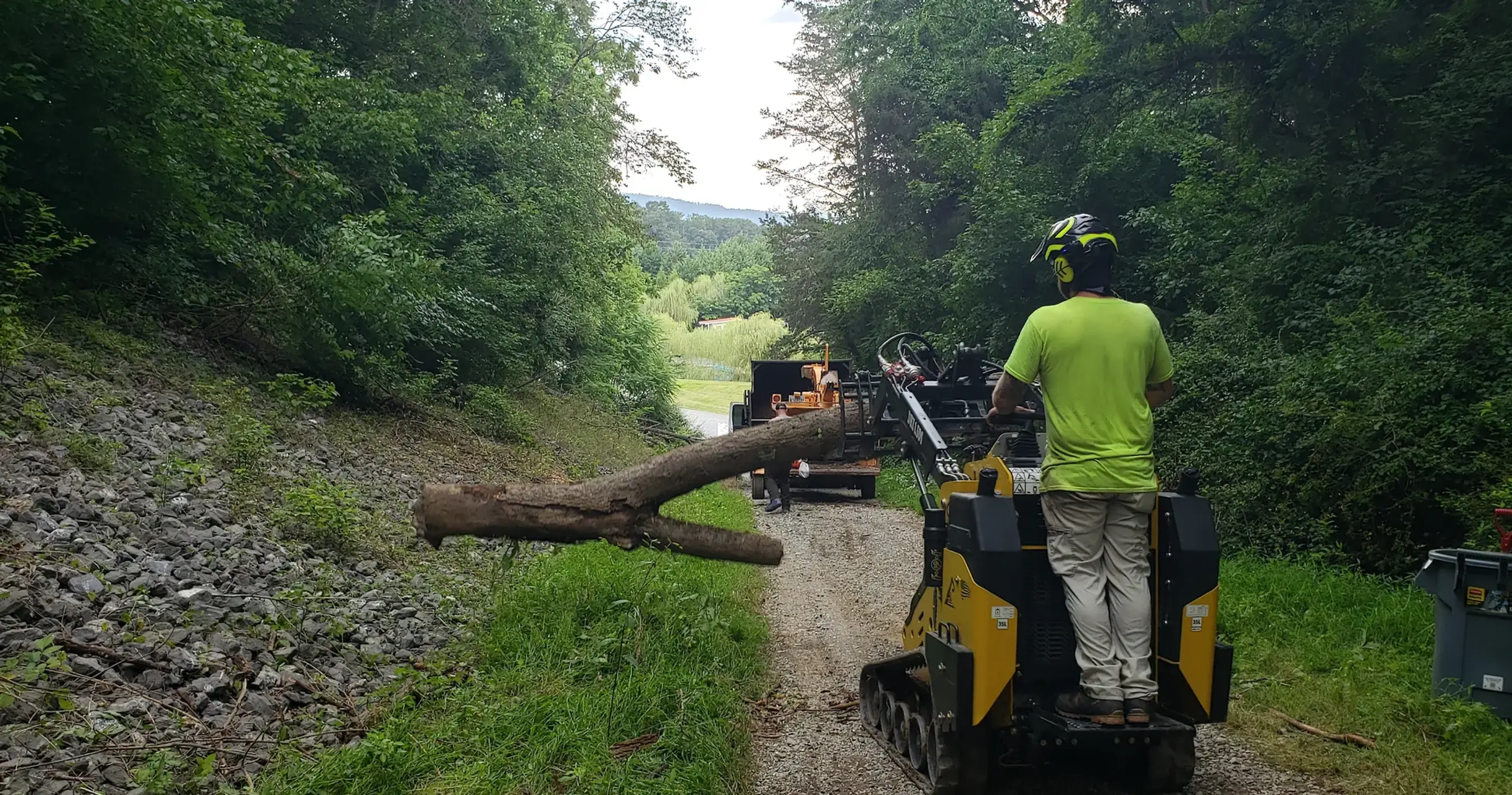
That is the strongest practical argument for a crane on a commercial site, and it is why we push toward one whenever access allows. A crane lifts large sections away cleanly instead of taking them down in small pieces, which compresses a multi day job into a day or less and keeps the work over a smaller footprint. On a site with tenants, customers, or traffic, fewer days on site is worth more than a slightly lower hourly rate.

Most tree services in this Valley do not do crane work at all. Derrick trained on cranes almost exclusively during his years working in Boston, where the company he worked for owned one and rented a second, so his formative years in the trade were spent almost entirely on crane production.
On the institutional side, earlier in his career he worked the University of Virginia campus among trees planted by Thomas Jefferson, including Kentucky coffeetrees and enormous Osage oranges. Campus and institutional grounds work is its own discipline, because the trees are frequently irreplaceable and the site never fully closes.
Practical scheduling: the crew is typically on site and working by 8:30 AM, and emergency response runs Monday through Saturday.
Rural landowners and land clearing
Rural work is a different animal from residential tree care, and it is the part of this business with the deepest family roots. Derrick is the fourth generation of his family in forestry. His great grandfather logged with mules. His grandfather went from mule to machine and built a logging and excavating company that employed around 50 men at its peak in the 1990s, excavating in the summer and logging in the winter. Derrick logged alongside him as a teenager before he ever climbed a tree professionally.
Land clearing and lot clearing
Clearing is priced per site rather than per tree, because the variables are acreage, terrain, access, what is standing on it, and what the ground needs to look like when the work is done. A lot being cleared for construction has different requirements from pasture reclamation or a right of way.

One decision comes up on nearly every clearing job: grind the stumps or pull them. For a single stump in a homeowner's yard, grinding is almost always the answer. It is cheaper, it leaves no hole, and nothing gets ripped out of the ground. On a lot clear with many stumps, the math flips. It makes sense to bring an excavator for a day and rip them all out, so nothing is left decaying underneath future construction. Decaying stumps under a slab or a foundation are a problem that shows up years later and is expensive to fix.
The other thing worth flagging on rural acreage is the same edge row issue that affects new developments, at a larger scale. Any time a stand of timber is opened up, whatever is left standing at the new edge is suddenly exposed to wind it never had to handle. Planning which trees remain matters as much as choosing which come out.
Tree removal cost by size, with good access
Insurance, documented. | $1,000,000 in general liability plus workers' compensation through Jenkins Insurance of Harrisonburg. A copy of the policy is attached automatically to every proposal we send, so you are not chasing a certificate before work can start. |
TCIA certified staff on every job site. | The Tree Care Industry Association credential is one of the two top credentials in this industry, and we certified staff first specifically so that every site has certified personnel on it. |
Permanent service records. | Every visit, every recommendation, and every treatment is recorded permanently in our management system. Future crews can see the full service history of a specific tree and how it responded to treatment over time. For an association or a management company, that means the record outlives whoever is currently on the board. |
Crane capability. | Rare in this Valley, and the difference between one day of disruption and a week of it |
Emergency response, Monday through Saturday. | Phone response is usually about 30 seconds and about 10 minutes at worst. On site response runs 20 minutes to roughly an hour and a half depending on distance. |
Proposals that stand up to a board. | Every proposal includes the insurance policy, the service and terms agreement, and a Google Maps image of the property with the work trees pinned, so there is no ambiguity later about which trees were in scope. |
Where we are honest about our limits
Commercial and association buyers ask harder credential questions than homeowners do, and they should. Here is our position, stated plainly, so nobody discovers it late.
Derrick Lawson is an arborist actively pursuing ISA certification. He is not currently ISA certified. Blue Mountain Arbor maintains TCIA certified staff on every job site.
We do not currently offer TRAQ assessments. A Tree Risk Assessment Qualification report requires a TRAQ certified arborist, and there are not many in this region. If your board, your insurer, or your municipality specifically requires a TRAQ report, we will tell you that on the first call rather than after you have spent a month with us.
We do not currently produce formal written assessment reports. Everything is documented in our system with photographs and a permanent service history, which is genuinely useful and survives staff turnover, but it is not the same thing as a written arborist report and we will not pretend otherwise.
We do not do tree appraisals for insurance claims yet, though it is a direction the business is heading.
All of these are things we are building toward as the company matures. Saying so costs us some jobs. It costs us fewer than overpromising would.
Pricing, terms, and scheduling
Assessments and estimates are free, for commercial and residential alike.
Deposits are required only on projects over $10,000, and the deposit is 10 percent.
No payment is due until the work is complete, then payment is due on receipt.
We accept check, cash, ACH, and credit card.
Scheduled work typically books two to three weeks out. Emergencies are immediate.
We bill the client directly and do not work through insurance adjusters. You file your own claim, and we supply extensive photo and video documentation to file with it.
Our service radius runs roughly an hour from our base in Elkton, with distance priced in toward the edge of that range.
We can only price your tree on site.
Free estimate, insurance policy attached to every proposal, and the first question is always whether the tree can be saved.
Frequently asked questions
What does commercial tree service include?
Removals, pruning, storm and emergency response, tree health assessments, stump grinding, and land or lot clearing on rural acreage. The work is the same as residential; what changes is coordinating it around tenants, residents, traffic, and liability.
Do you carry insurance, and can you provide a certificate?
Yes. We carry $1,000,000 in general liability plus workers compensation through Jenkins Insurance of Harrisonburg, and a copy of the policy is attached automatically to every proposal, so you are not chasing paperwork before work can begin.
Do you offer TRAQ assessments or written tree risk reports?
Not currently. TRAQ reports require a TRAQ certified arborist and we do not have that credential yet, and we do not produce formal written arborist reports. We document everything with photographs and a permanent service history instead. If your board or insurer requires a TRAQ report specifically, we will say so on the first call.
Do you do land clearing?
Yes, for rural landowners across the service area. Clearing is priced per site rather than per tree, because acreage, terrain, access, what is standing, and the finished condition of the ground all drive the work.
How much does land clearing cost?
It is quoted per site after a walk of the property, because no two clearing jobs share the same variables. The assessment visit is free.
Should stumps be ground or excavated on a cleared lot?
For a single stump in a yard, grinding is almost always better: cheaper, no hole left behind, and nothing ripped out of the ground. On a lot clear with many stumps, it usually makes more sense to bring an excavator for a day and pull them all, so nothing is left decaying under future construction.
Can you work around business hours and tenants?
Yes, and it is a large part of why we push toward crane work on commercial sites when access allows. A crane compresses a multi day job into a day or less and keeps the work over a smaller footprint, which usually matters more to a business than the hourly rate does.
Why do trees in new developments fall more often?
Because builders often leave a single row of trees between lots, and trees take wind together as a forest. Interior trees grow up sheltered and never develop for exposure, so when everything around them is removed, that remaining row absorbs the full force of storms it used to share. Wind snap and blowdown risk climb sharply.
Do you require a deposit on commercial projects?
Only on projects over $10,000, where the deposit is 10 percent. On everything else, nothing is due until the work is finished, then payment is due on receipt.
How far out do you book commercial work?
Scheduled work typically books two to three weeks out. Emergency situations get an immediate response Monday through Saturday, with phone response usually inside 30 seconds.
Who is responsible for a tree on a property line?
That depends on local ordinance, your association's governing documents, and the specific circumstances, and it is a legal question rather than an arboricultural one. We can tell you the condition of the tree and what it needs; for who pays, ask your association's counsel or an attorney.


